
User Personas vs Jobs-to-be-Done: Why One Drives Better Product Decisions
Most personas fail to guide product decisions. Learn why Jobs To Be Done delivers clearer evidence, better prioritization, and higher feature adoption.
If you are deciding what to build, use Jobs To Be Done (JTBD). If you are aligning stakeholders or writing marketing copy, use lightweight personas. Most product teams flip this, over-invest in detailed personas and under-invest in JTBD, which is why their "user understanding" rarely changes what ships.
Below is a practical guide to when personas work, when they fail, and how to make JTBD your default for product decisions.
What's the real difference between personas and Jobs To Be Done?
Personas answer:
"Who is this roughly for?"
Jobs To Be Done (JTBD) answers:
"In what situation do they hire our product, why, and what outcome proves it worked?"
- Personas are communication tools: role + context + shared language.
- JTBD is a decision tool: evidence-backed situations, motivations, and outcomes that drive roadmaps, specs, and metrics.
If you are trying to decide:
- "Which feature should we build next?"
- "What metric defines success for this initiative?"
- "How should we architect this flow for real usage?"
…then JTBD beats personas every time.
Why do most user personas fail in product management?
Teams burn weeks crafting persona decks that look impressive and change nothing.
Common failure pattern:
- You create "Jessica, 35, urban professional, tech-savvy."
- You add a photo, a quote, hobbies, favorite coffee.
- Meanwhile, real users are opening support tickets about basic issues you have not fixed.
- Conversations in planning meetings shift to "Would Jessica like this?" instead of "What evidence do we have?"
The core problems:
- Assumptions packaged as "insights"
- Fictional backstories are rarely grounded in actual user interviews, logs, or sales calls.
- The document feels dense, but most statements are untested opinions.
- Illusion of understanding
- Because personas look polished, teams feel done with discovery.
- That false sense of completion blocks more user research.
- No clear link to decisions
- Personas rarely specify which problem to solve first, how to measure success, or what trade-offs to make.
- They describe people, not choices.
Result: Persona PDFs gather dust in shared drives while product decisions default back to HiPPO, roadmap inertia, or anecdotal opinions.
How does JTBD fix what personas get wrong?
The Jobs To Be Done framework (popularized by Clayton Christensen, Bob Moesta, and others) starts from a different premise:
Users don't buy products; they hire them to make progress in a specific situation.
Instead of "Jessica, 35," you document:
- The situation she is in right before she needs help.
- The motivation that pushes her to seek a solution now.
- The outcome that tells her the job is successfully done.
Example (SaaS work management product):
- Situation: "On Monday mornings, when I'm staring at a chaotic backlog of feature requests across Slack, email, and sales calls…"
- Motivation: "…I want to quickly organize and prioritize the most important work so my team knows what to ship this sprint…"
- Outcome: "…so we reduce time spent wrangling priorities from 5 hours per week to 1 hour and avoid shipping low-impact features."
Notice what changes:
- No demographics.
- No fictional hobbies.
- Clear trigger, clear motivation, clear measurable result.
The three components of a strong JTBD statement
A usable JTBD statement has three parts that can be traced back to real evidence:
- Situation (context + trigger)
- "When I'm [context] and [trigger] happens…"
- Evidence: user interviews, call notes, support tickets, observational studies.
- Motivation (struggle + desired progress)
- "…I want to [specific progress]…"
- Evidence: direct quotes about frustrations, goals, and constraints.
- Outcome (measurable success)
- "…so that [objective outcome] happens."
- Evidence: defined metrics, "before vs after" numbers, behavioral events.
If any of these three is vague or unverifiable, you don't understand the job yet, you have a hypothesis.
Teams that use JTBD templates notice something uncomfortable but useful:
- Their documents start highlighting gaps.
- "We don't know what success looks like yet."
- "We don't actually know what users do right before this."
That discomfort is the point. It pushes more discovery instead of more fiction.
Quick comparison: Personas vs JTBD (what to use when)
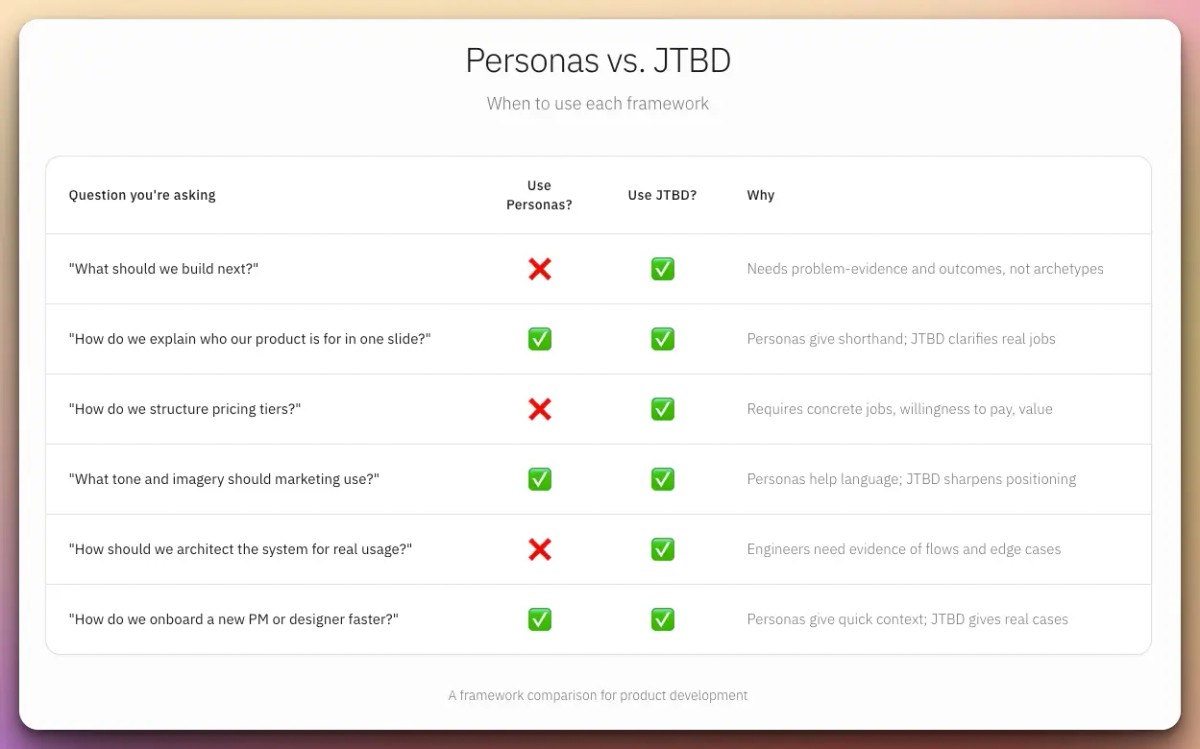
Rule of thumb:
- Use personas for communication and storytelling.
- Use JTBD for decisions, prioritization, and success metrics.
Why engineers distrust personas and prefer JTBD
If your engineers roll their eyes at persona decks, they are not being difficult. They are reacting to low-signal inputs.
Engineers want:
- Real user quotes, not fictional "Jessica says…" snippets.
- Actual usage patterns from logs and analytics.
- Clear constraints and success metrics ("p95 latency under X ms", "task completion < 2 minutes").
- Known edge cases drawn from real workflows.
JTBD documents give them:
- Concrete situations that must be supported in the UX and architecture.
- Sequence of steps users actually take (including messy workarounds).
- Quantitative outcomes that define "done."
If you want better PM–engineering relationships:
- Share JTBD cases in grooming, not persona slides.
- Tie requirements back to specific jobs and evidence, not demographic labels.
When should product teams still use personas?
Personas are not useless. They are just misapplied.
Personas work well for:
- Stakeholder communication:
- Quickly explain "the kind of customer" to execs, sales, and marketing.
- Sales enablement:
- Give reps a mental model of who they talk to and how that role talks.
- Design context:
- Choose language, tone, imagery, and examples that feel natural to typical users.
- Onboarding new teammates:
- Provide a fast, human-feeling summary of your market segments.
Personas fail when they are asked to:
- Decide which problem deserves investment first.
- Justify complex technical trade-offs.
- Define success metrics for features or initiatives.
- Replace regular customer contact.
The mistake is trying to make personas do strategy and discovery work they are not designed for.
How to create lightweight personas that actually help
If your organization demands personas, keep them brutally simple and tie them to real jobs.
Effective persona structure (2–3 lines each):
- Role + context:
“Engineering Manager at 50–500-person B2B SaaS companies.” - Primary responsibilities:
“Responsible for delivery predictability and tech debt trade-offs.” - Top 2–3 JTBDs:
“Needs to prioritize engineering work against product asks; needs to communicate capacity constraints to leadership.”
You don’t need:
- Favorite coffee drink.
- Weekend hobbies.
- Fictional first names or photo shoots.
Those details create the illusion of intimacy without adding decision-relevant information.
The Persona → Jobs → Evidence chain (how to keep personas honest)
When stakeholders push solutions “for the persona,” you need a way to anchor the conversation back to reality.
Use a simple Persona → Jobs → Evidence chain:
- Persona (who, at a glance)
- “Engineering Manager at 50–500 person B2B SaaS.”
- Jobs (what they’re trying to get done)
- “Quickly prioritize feature requests against tech debt.”
- “Prove to leadership that the team is working on the highest-impact items.”
- Evidence (what proves these jobs are real)
- 3+ user quotes from research.
- Screenshots or logs showing current workaround behavior.
- Support tickets or Slack excerpts that show the struggle.
- Metrics that move when the job is better served.
When someone proposes a feature:
- Check: “Which job does this serve for which persona?”
- Then: “What evidence do we have that this job matters enough to justify the work?”
Teams that use this chain report:
- Fewer features built for fictional edge cases.
- Clearer conversations with stakeholders: disagreements move from taste to evidence.
A simpler approach for B2B product management
B2B teams often drown in persona complexity:
- “Do we need separate personas for Admin, Buyer, End User, Champion, Influencer?”
- “What about company size, industry, region, tech stack?”
A simpler approach:
- Treat the company as the primary persona
- “Mid-market B2B SaaS companies (100–1,000 employees) selling to US/EU markets.”
- Use roles as contextual lenses, not separate personas
- Product Manager, Business Analyst, Admin, IC User, Executive Sponsor.
- Each role has its own jobs, but they live under one company-level context.
- Anchor everything on jobs that repeat across roles
- “Consolidate feature requests into a single backlog.”
- “Report product impact to leadership clearly.”
- “Make sure customers adopt the features they pay for.”
A PM and a Business Analyst at different companies might hire your product for the same core job, even though their titles and demographics differ. That insight simplifies your strategy far more than trying to maintain 15 detailed persona profiles.
A practical 4-part template to replace heavy personas
Instead of a 20-page persona deck, maintain a 4-part user understanding doc for each core job:
- Who (Role + Context)
- 1–2 lines.
- Example: “Product Managers at B2B SaaS companies managing a high volume of feature requests without dedicated tooling.”
- Problem Evidence (3 concrete examples)
- Real quotes from interviews or calls.
- Situations that triggered the search for a solution.
- Example:
- “I spend half my Monday just collating requests from Slack, email, and sales.”
- “Leadership asks why we shipped X instead of Y, and I don’t have a clear answer.”
- “We lose track of customer promises made in calls.”
- Current solutions / workarounds
- What users do today without you: spreadsheets, Notion, email threads, Jira hacks.
- These show pain, friction, and willingness to pay.
- Success metrics (specific and measurable)
- How you and the user will know the job is done well.
- Example: “Reduce time spent prioritizing from 5 hours to 1 hour weekly.”
- Example: “Increase alignment score in sprint retros from 5/10 to 8/10.”
This 4-part document:
- Takes less time to produce than a typical persona deck.
- Is easier for AI tools and humans to extract signal from.
- Directly informs product decisions, not just slideware.
Why "perfect personas" get in the way of real user understanding
Teams often build detailed personas because fiction is emotionally safe:
- Fictional users never contradict your assumptions.
- They never tell you your idea is irrelevant.
- They never complain about performance, bugs, or onboarding.
JTBD, in contrast, forces you into contact with reality:
- If you cannot clearly describe the situation, you haven’t observed enough.
- If you cannot write down measurable outcomes, you don’t know what success is.
- If you cannot list current workarounds, you don’t deeply understand the pain.
That feels risky—but it produces better products.
High-performing teams embrace this discomfort:
- They regularly discover “we actually have no idea what users do before/after this step.”
- They treat that as a signal to run more interviews, not as a reason to invent more persona details
Common mistakes with both personas and JTBD (and how to avoid them)
Persona mistakes:
- Over-specificity that doesn’t affect decisions.
- Example: “Drinks oat-milk cortado,” “travels to Bali twice a year.”
- Treating persona documents as research instead of hypotheses.
- Letting persona creation substitute for actual customer conversations.
JTBD mistakes:
- Writing features, not jobs.
- Bad: “Users need to drag and drop files.” (feature)
- Good: “Users need to quickly organize documents from multiple sources into project-specific collections.” (job)
- Staying vague on outcomes.
- Bad: “Improve productivity.”
- Good: “Cut time spent preparing weekly status updates from 90 minutes to 20.”
- Not tying jobs back to observable behavior.
- A job without logs, quotes, or workarounds is just a theory.
Avoid both sets of mistakes by constantly asking:
“Where is the evidence for this sentence?”
If you cannot point to a user quote, log, experiment, or metric, mark it as a hypothesis.
How product leaders should guide the team (personas + JTBD together)
As a product leader, you probably face:
- Stakeholders asking for detailed personas “like they saw in a workshop.”
- Design teams expecting personas for consistency.
- Marketing wanting segmentation documents.
You do not have to choose personas or JTBD. You have to separate their jobs.
- Set a persona standard
- Max 2 lines per persona: role + context.
- Used for: decks, sales, design language, onboarding.
- Set a JTBD standard for decisions
- Every roadmap item must link to at least one JTBD statement with:
- Situation, motivation, and outcome.
- 3+ pieces of problem evidence.
- Known current workarounds.
- Clear success metrics.
- Every roadmap item must link to at least one JTBD statement with:
- Institutionalize regular user contact
- Expect PMs and designers to talk to users weekly (or at least several times per month).
- Ask in review meetings: “What surprised you in recent user conversations?”
- If no one has a recent surprise, you have a research gap—not a communication problem.
- Give explicit permission to challenge assumptions
- Make it normal to say: “We don’t have evidence for this persona claim.”
- Reward teams for finding contradictions between assumptions and reality.
Personas remain for alignment. JTBD becomes the gateway for investment decisions.
Measuring whether JTBD is actually helping
One simple metric tells you if this shift is working:
What percentage of shipped features see meaningful adoption from their target users within a defined time window?
Teams that use JTBD to drive decisions tend to observe:
- Higher adoption rates for new features.
- Fewer “nice-to-have” features that users ignore.
- Clearer mapping from roadmap items to user outcomes and business metrics.
Practically:
- Tag each feature with the primary job it serves.
- After launch, check: Did the behavior tied to that job actually change?
- Time saved, error rate, frequency, depth of use, retention, etc.
If you cannot tie behavior change to a job, you likely built for a fictional need.
The real competitive advantage: user understanding, not documentation format
It is tempting to argue about frameworks:
- “Are personas outdated?”
- “Is JTBD just a fad?”
- “Which template should we use?”
Those debates miss the point.
Your competitive advantage comes from:
- Talking to real users more often and more deeply than your competitors.
- Systematically collecting evidence (quotes, logs, tickets, experiments).
- Challenging your own assumptions with that evidence.
- Using frameworks (JTBD, personas, whatever) to expose knowledge gaps, not hide them.
In that world:
- Lightweight, evidence-linked personas help everyone speak the same language.
- JTBD framework drives what you build, how you measure success, and how you explain trade-offs.
Stop optimizing the persona template. Start increasing the frequency and quality of user conversations.
Your next breakthrough will not come from adding another fictional detail to “Jessica, 35.”
It will come from understanding the specific job your real users are trying to get done, and backing that understanding with evidence you can trace directly to real problems.